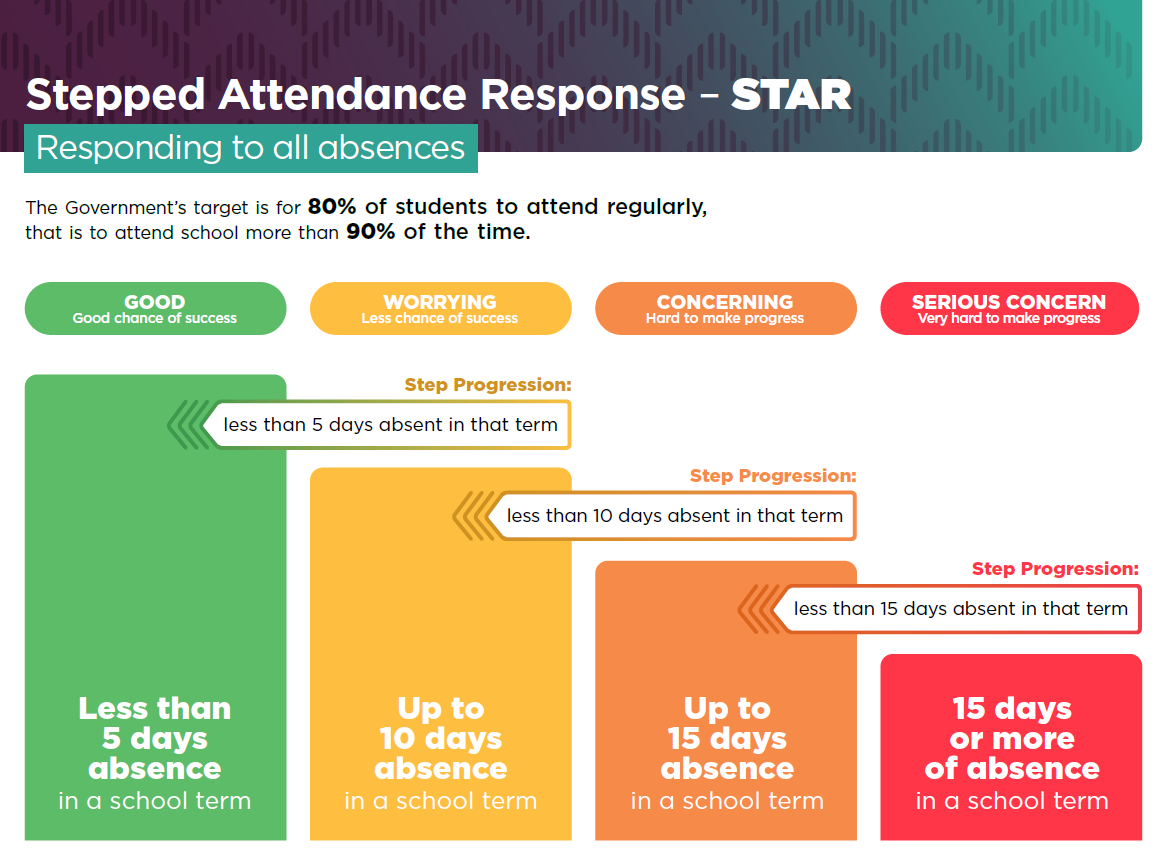
The government’s Stepped Attendance Response (STAR) is the support programme that the Ministry of Education is rolling out to help clarify why attendance is so important and what we can do to maximise educational opportunities by having more children with “regular attendance” at school. The Education Review Office (ERO) reports a direct relationship between attendance and school achievement, stating that regular attendance leads to higher academic achievement and that even minor absences can impact learning and long-term outcomes.
The Stepped Attendance Response (STAR) is to help the educational community in New Zealand to set clear expectations and have a regulated, formalised and graduated approach when attendance starts to slip. When students reach certain “absence thresholds” that would take them below the 90% for “regular attendance”, the government has set up a guide to the responses that schools will take. These responses are designed to bring students and their families back into school. We will send formal emails to inform you if absences grow, and we will use resources and systems inside the school to remove barriers to attendance for your child. We may also need to use outside agencies to help you get your child back to regular school attendance.
STAR Attendance Procedure
Consistent with the Ministry of Education’s definition of regular attendance, AV头条 expects attendance above 90% and emails containing attendance data, will be sent each Monday. Wh膩nau are to ensure these are reviewed when received, as they are the first step in our collaboration to support students to succeed.
Our key aim is to work with families to ensure that learners do not fall behind in their learning. Learners are expected to be present, participating and progressing. Both home and school have a role to play in this.
 Furthermore, attending school regularly relates directly to our school values:
Manaakitanga | Care
Turning up to school is about taking responsibility for our collective future. Just as we care for the environment and school resources, we also need to care for our own learning journeys. Attending school regularly enhances each student’s future opportunities and contributes to a stronger, more sustainable community where everyone has the chance to succeed.
Manawa reka | Curiosity
When students attend school regularly, they give themselves the best chance to grow, learn, and reach their full potential. Being present means being part of opportunities: academic, cultural, sporting, and social in order to help each student to become their best selves. Being present in class, and participating actively in the learning journey is preparing our students in their role as lifelong learners. Regular attendance is a key step in personal empowerment and striving for excellence.
M膩ia | Courage
AV头条 is a part of the community and our relationship with our students extends out to their wh膩nau. We are a team. For a team to function at the highest level we need to be able to trust each other. A part of this relationship is reaching out when you need help with eliminating barriers for attendance. It is important to have someone at school who can support you if issues or new barriers arise. This might be your child’s Mentor teacher, a subject teacher you and your child trusts or could even be a student support network at AV头条.

Escalation Response
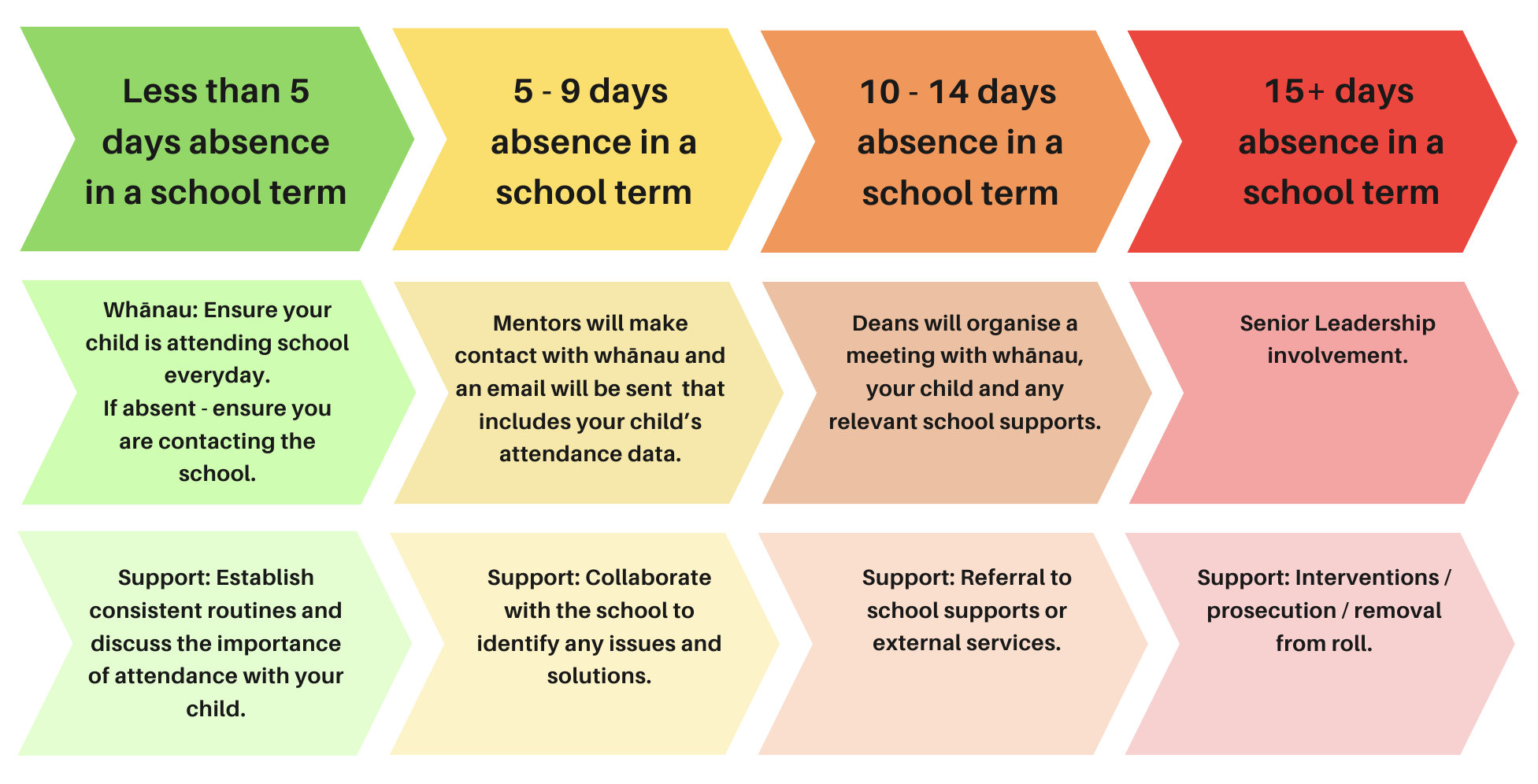
The following escalation approach reflects the Government’s “Stepped Attendance Response” (STAR) system.
GOOD (Good chance of success) 1-4 days absent in a school term:
Your child is regularly attending school, and students will receive positive acknowledgement throughout the term.
WORRYING (Less chance of success) 5-9 days absent in a school term:
Wh膩nau will receive an email from your child’s Mentor teacher. This is an opportunity to make the Mentor teacher or Dean aware of any barriers that your child has with attending school. Together you will create a plan to make sure your child can attend school regularly and any barriers to attendance can be addressed positively.
CONCERNING (Hard to make progress) 10-14 days absent in a school term:
Wh膩nau will receive notification from your child’s Dean who will organise a time to discuss the current barriers to regular attendance. Any support/s we can put in place internally and externally of the school will be arranged. Together, we will create a Wh膩nau Action Plan. We will continue to monitor and support your child until they return to regular attendance.
SERIOUS CONCERN (Very hard to make progress) 15+ days absent in a school term:
Wh膩nau will receive notification from the Senior Leadership Team. You will be asked to attend school and meet with your child’s Deputy Principal in person, alongside your child, to discuss the challenges you are facing as a wh膩nau. Other agencies may be asked to attend this meeting along with a possible referral to our truancy officer. This service supports students and their families who have not attended school for a while.